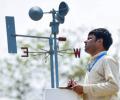
'This system will be of immense help in agricultural planning, disaster management and water resources management.'

China's national observatory issued a red alert -- the highest level in the country's typhoon warning system -- as Typhoon Dolphin hit Zhejiang province on the eastern coast on Sunday afternoon.
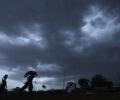
Installed at a cost of Rs 450 crore in Pune and Noida, the two supercomputers are set to fundamentally alter the weather forecasting scenario in India by enabling the IMD to forecast severe weather conditions up to the sub-district or block level.

'All El Ninos are not associated with the deficient monsoon.'

From a few rain gauges in 1875 to rivalling the world's best weather agencies, the India Meteorological Department (IMD) has weathered its way to becoming a global leader in forecasting.

'Nobody asked us to work on this. It was on our own that we decided to embark on this journey.'

The official India Meteorological Department (IMD) and the private Skymet Weather Services have made widely divergent monsoon forecasts.

Prime Minister Narendra Modi on Thursday said a country can aim for high achievements only if it has a big vision and asserted that technology upgradation should be to empower the poor. Speaking after launching via video link three PARAM Rudra supercomputers, developed indigenously under National Supercomputing Mission, Modi asserted that today's India is carving new opportunities in the infinite sky of possibilities. Modi said his government has taken steps to ensure research in technology benefits the common man.

As weather patterns grow more unpredictable due to climate crisis, India is taking a giant leap with "Mission Mausam" to improve weather understanding and forecasting through expanded observation networks, better modeling and advanced tools like AI and machine learning.

ISRO chairman S Somanath said the success gave the space agency "greater confidence," as the GSLV will be next deployed in the NISAR mission, a collaborative effort with the US' NASA.


S&P Global Ratings on Monday retained India's GDP growth forecast at 6 per cent saying it will be the fastest growing economy among Asia Pacific nations. The GDP growth forecast for the current and the next fiscal has been kept unchanged from the forecast made in March partly on account of domestic resilience. "We see the fastest growth at about 6 per cent in India, Vietnam, and the Philippines, S&P Global Ratings said in its quarterly economic update for Asia-Pacific.

Orissa learnt its lessons from previous cyclones, particularly the 1999 super cyclone, whereas Uttarakhand has failed to do so from any of the previous natural calamities that hit the state, says Dinesh C Sharma.

Moody's Investors Service on Friday said India's economy is expected to contract for the first time in more than four decades saying economic damage owing to the coronavirus-induced lockdown will be significant with lower consumption and sluggish business activity. Even before the coronavirus outbreak, Indian economy already was growing at its slowest pace in six years and with the stimulus measures announced by the government falling short of expectations, the disruptions are likely to be greater. "We now expect India's growth to register a real GDP contraction for the fiscal year ending in March 2021 (fiscal 2020-21), from our earlier projection of zero growth," it said in a research note.

Why is Xi Jinping visiting Saudi Arabia, Egypt and China this week? Former RA&W officer Jayadeva Ranade explains the significance of China's outreach to the Middle East.
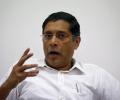
Chief Economic Advisor Arvind Subramanian says that he hopes GDP growth will be at the upper end of the 7-7.5 per cent range.
